> For the complete documentation index, see [llms.txt](https://help.defisaver.com/llms.txt). Markdown versions of documentation pages are available by appending `.md` to page URLs; this page is available as [Markdown](https://help.defisaver.com/features/defi-saver-dashboard/health-safety-and-collateral-ratio.md).
# Health, Safety and Collateral Ratio
There are three risk metrics/parameters that users will see on DeFi Saver. These include:
Health Ratio
The Health Ratio is Aave's indicator of the position's overall health. Once it reaches 1, the position is liquidated.
It's calculated as:
> *Health Ratio = (collateral value \* liquidation factor) / debt value*
>
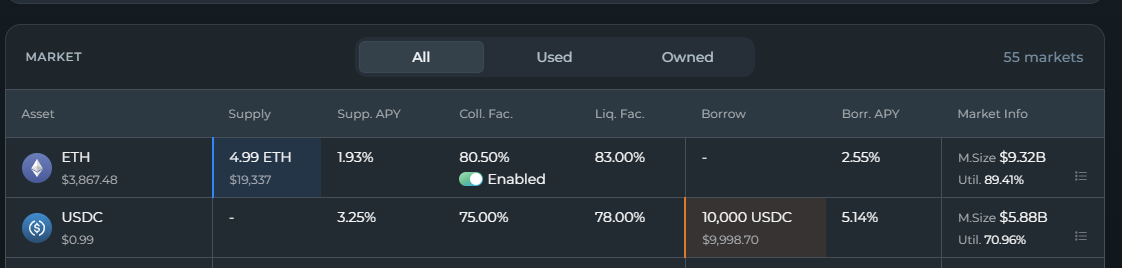
> So if we take the example from the screenshot below, we'd have:
>
> *Health Ratio = (19,337 \* 0.83) / 9,998.70*
>
> *Health Ratio = 1.60*
{% hint style="info" %}
*Information about the collateral asset's liquidation factor (Liq. Fac.) can be found in the "Market" section of the Aave dashboard*
{% endhint %}
Collateral Ratio
The Collateral Ratio represents the % difference between your collateral and your debt in dollar amounts.\
\
It's calculated as:
> *Collateral Ratio = (collateral dollar amount / debt amount) \* 100*
>
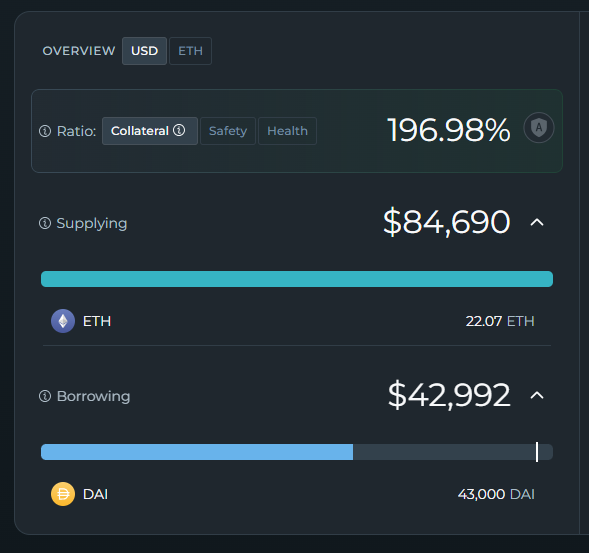
> So if we take the example from the screenshot below, we'd have:
>
> *Collateral Ratio = ($84,690/ $42,992) \* 100*
>
> *Collateral Ratio = 196.98%*
Safety Ratio
The Safety Ratio is a measure of how far you are from liquidation, expressed as a percentage.\
\
It is inversely proportional to your borrow power used, so the more you borrow, the lower your Safety Ratio.\
\
It's calculated as:
> *Safety Ratio = (( Collateral in dollar value \* collateral factor) / debt amount in dollar value) \* 100*
>
> So if we take the example from the screenshot below, we'd have:
>
> *Safety Ratio = (( $78,979 \* 0.8) / 35,002) \* 100*
>
> *Safety Ratio = 181.63%*
{% hint style="info" %}
*Information about the collateral asset's collateral factor/LTV (Col. Fac.) can be found in the "Market" section of the Aave dashboard*\
\
*Collateral Factor is the same metric as LTV.*
{% endhint %}
{% hint style="info" %}
*Depending on the protocols you use, they may only use one risk parameter (e.g. Collateral Ratio for Maker, or a protocol-specific one like Health Ratio for Aave v3)*
{% endhint %}
Using the calculations in this article will help you make projections for your position - such as how much a specific price change in your collateral's value would impact your health metrics.