> For the complete documentation index, see [llms.txt](https://help.defisaver.com/llms.txt). Markdown versions of documentation pages are available by appending `.md` to page URLs; this page is available as [Markdown](https://help.defisaver.com/protocols/makerdao/managing-the-dashboard.md).
# Managing the Dashboard
Short overview of the process, including the difference between creating a normal vs leveraged CDP.
Creating a CDP/Vault with DeFi Saver is a fairly straightforward process. To begin, navigate to the MakerDAO dashboard in the left sidebar.
Once you're there, these are the steps:
1. Select your wanted collateral typeCurrently ETH, WBTC, USDC, PAXUSD, LINK, BAT, LRC, MANA, ZRX, KNC, COMP and USTD are supported in MakerDAO and you can check their stats at [DeFi Explore](https://defiexplore.com/stats).
2. Input the amount of collateral you want to deposit
3. Select the amount of DAI debt you want to generateNote that there is a minimum of 100 DAI debt in MakerDAO, meaning anything between 0 and 100 is not allowed by the protocol.
### Normal vs Leveraged CDP/Vault
When creating a CDP at DeFi Saver you have the choice of creating a standard CDP or an instantly leveraged one. If you're unsure what the difference is, here is a comparison:
* Normal: All generated DAI is sent to your account and you can do use DAI freely for whatever purposes.
* Leveraged: All generated DAI is instantly used to obtain more ETH (or whichever used collateral) for your position using one of the integrated decentralized exchanges. Consequently, you do not receive any DAI to your wallet account.
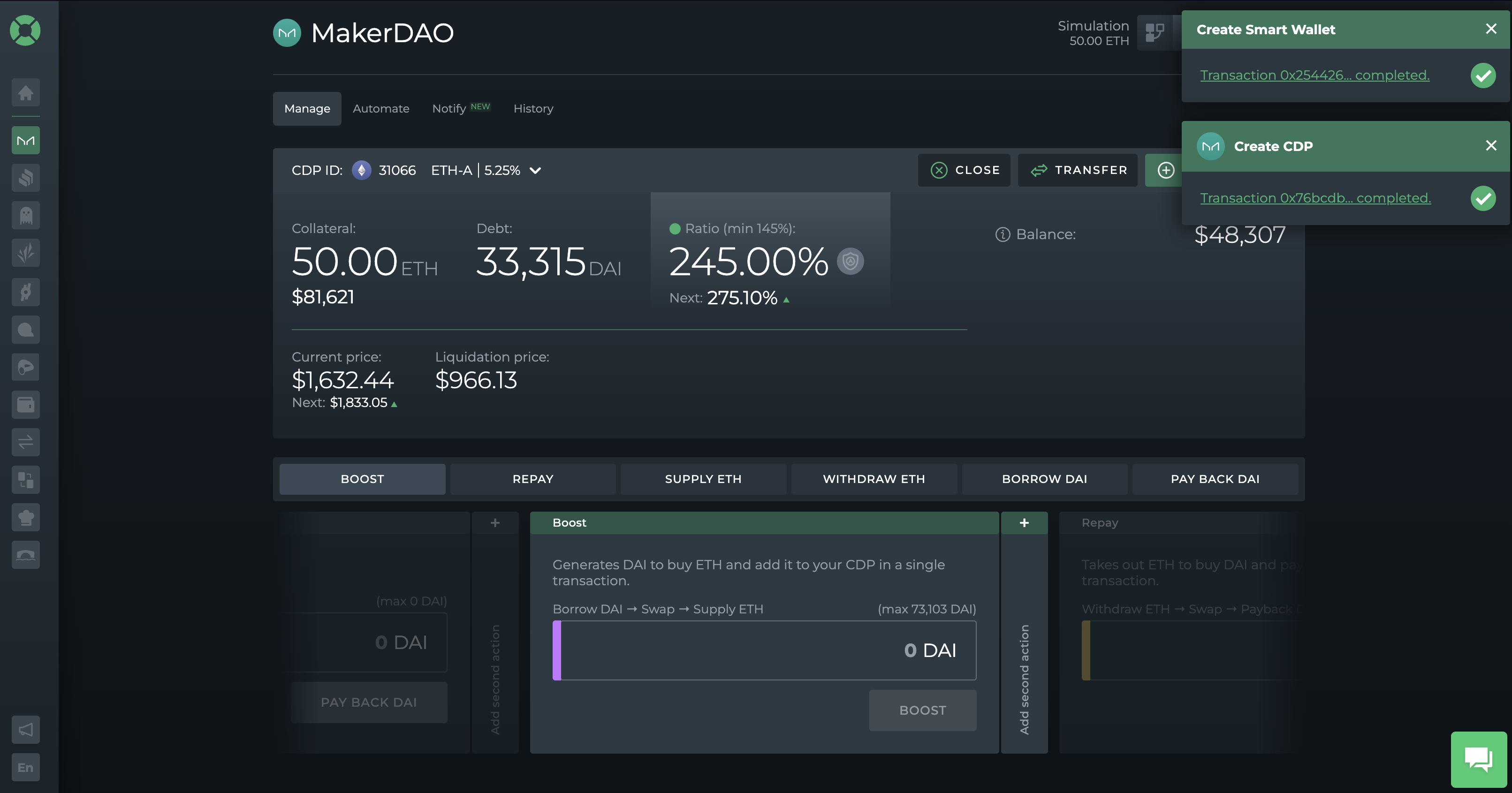
Example of a MakerDAO position
Please note that there is a 0.25% service fee for creating an instantly leveraged CDP/Vault.